
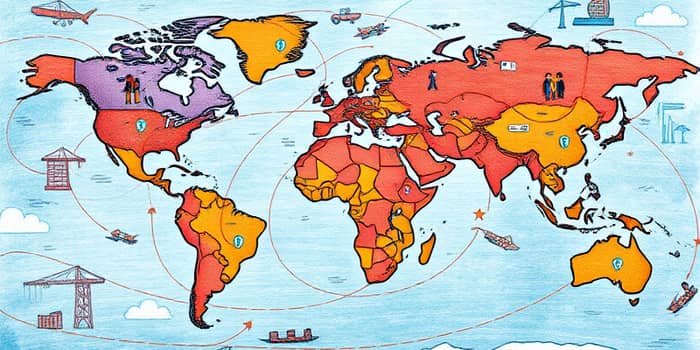
In an era of intertwined economies, investors and businesses are charting paths across continents to capture emerging growth pockets. From the resilience of advanced markets to the dynamism of the Global South, distinct regional growth trajectories are reshaping strategies and inspiring new ventures.
By weaving together macroeconomics, sectoral trends, and cross-border flows, this exploration offers practical insights and an inspiring narrative to guide stakeholders in seizing opportunities beyond their home turf.
A Shifting Macro Backdrop: Growth, Trade, and Capital Flows
Global expansion is slowing, but not stalling. UNCTAD expects global growth to slow to 2.3% in 2025, dipping below the 2.5% “recessionary” threshold. J.P. Morgan’s baseline is slightly firmer at 2.5%, coupled with core inflation near 3% and a high-for-longer rate environment. S&P Global sees resilience across major economies, nudging forecasts upward despite policy unpredictability.
Trade remains a pillar of growth. McKinsey pegs total trade at nearly $33 trillion in 2024, while UNCTAD reports goods trade growth near 5% and services trade growth around 6% on a rolling basis. Investment in logistics and infrastructure is ramping up, reflecting a surge in large public and private investment in ports, rail, and energy transition assets.
Unlocking Opportunities in the Americas
The United States, propelled by strong AI-driven capital spending and a healthy labor market, may remain the growth engine of the next cycle. Incoming trade policies could impose new tariffs, particularly on China, injecting uncertainty but also creating bilateral arbitrage.
- Expanding AI-related capital spending driving infrastructure needs.
- Trade balance shifts narrowing U.S.–China deficits.
- Sector hotspots: Technology, energy transition, and healthcare.
Reinventing Growth in Europe
Europe faces structural headwinds, from divergent monetary policies to fiscal constraints, but significant tailwinds exist. Defense budgets are rising amid geopolitical friction, and green infrastructure projects promise fresh industrial demand.
- Defense and dual-use technologies receiving budget boosts.
- Green and transport infrastructure projects.
- ICT, tourism, and professional services expansion.
Asia Pacific: The Engine of Intra-Regional Trade
China’s growth deceleration to around 3.9% in 2025 underscores the shift toward regional integration. South–South trade now represents one third of global commerce, with East and Southeast Asia as key drivers.
Companies are diversifying beyond China via “China+1” strategies, fueling manufacturing hubs in Vietnam, India, and Indonesia. Meanwhile, outbound M&A by APAC buyers into the Americas doubled their deal allocation, signaling cross-border appetite.
- Electronics and EV manufacturing hubs in Southeast Asia.
- Regional trade pacts and supply-chain realignment.
- Outbound M&A boosts tech and consumer assets abroad.
Emerging Markets and the Global South
Emerging economies grapple with subdued external demand and capital flows tilting to “safe” assets, yet growth ex-China often outpaces advanced peers. South–South trade and regional value chains are structural positives that can outlast cyclical headwinds.
Integration efforts—from African Continental Free Trade Area to Latin American alliances—illustrate how local networks can substitute for traditional North–South flows, fostering resilience and unlocking scale.
Digital services exports, climate projects, consumer growth, and logistics upgrades beckon entrepreneurs and investors seeking diversified, high-potential markets.
Structural Themes and Sector Hotspots
- Clean energy and power infrastructure, needing trillions annually.
- Advanced manufacturing: semiconductors, hybrid vehicles, electronics.
- Digital economy: AI, cloud, data centers, cybersecurity.
These cross-border themes are durable, attracting capital across geographies and aligning with global decarbonization and digitalization agendas.
Cross-Border Capital, M&A Flows, and Talent Dynamics
Global capital is tilting toward advanced markets, yet pockets of value in developing regions remain. Private markets are channeling billions into trade-related infrastructure and energy transition, seeking stable long-term returns.
Corporate M&A reflects this duality: APAC buyers are hunting assets globally, while U.S. and European firms selectively acquire in high-growth EM sectors. Dealmakers must balance valuation discipline with thematic conviction.
Labor markets and skills shortages in green and digital domains are spurring cross-border talent flows. Strategic collaboration with local institutions can alleviate skills shortages in digital and green sectors, forging sustainable human capital pipelines.
Navigating Risks: Challenges Along the Way
Policy unpredictability—whether tariffs, sanctions, or regulatory shifts—can unsettle markets. A high-for-longer rate environment poses refinancing risks, especially for emerging-market borrowers.
Geopolitical tensions and supply-chain disruptions threaten continuity. Climate risks—from extreme weather to carbon constraints—demand robust scenario planning.
Mitigation strategies include portfolio diversification, hedging strategies, and deep local partnerships that blend global insights with regional expertise.
Conclusion: Charting a Course Beyond Borders
In a complex global tapestry, opportunities abound for those willing to navigate uncertainty with discipline and creativity. By embracing resilience through strategic diversification and aligning with enduring structural themes, businesses and investors can thrive.
As markets evolve, the most successful actors will be those seizing cross-border opportunities confidently, forging networks that span continents and deliver sustainable growth for years to come.
References
- https://www.pwc.com/gx/en/services/deals/trends.html
- https://unctad.org/publication/global-trade-update-october-2025-global-trade-remains-strong-despite-policy-changes-and
- https://www.jpmorgan.com/insights/global-research/outlook/market-outlook
- https://www.oecd.org/en/data/insights/statistical-releases/2025/08/international-trade-statistics-trends-in-second-quarter-2025.html
- https://www.mckinsey.com/industries/private-capital/our-insights/global-private-markets-report
- https://www.bea.gov/news/2025/us-international-trade-goods-and-services-august-2025
- https://unctad.org/publication/trade-and-development-foresights-2025-under-pressure-uncertainty-reshapes-global
- https://www.weforum.org/publications/the-future-of-jobs-report-2025/digest/
- https://www.hinrichfoundation.com/research/how-to-use-it/global-trade-outlook-and-statistics-update-october-2025
- https://dataweb.usitc.gov
- https://www.bny.com/corporate/global/en/insights/gears-in-motion-global-market-outlook-2025.html
- https://oecdstatistics.blog/2025/04/17/5-things-you-should-know-about-international-trade-statistics/
- https://www.worldbank.org/en/publication/global-economic-prospects
- https://www.spglobal.com/ratings/en/regulatory/article/global-economic-outlook-q4-2025-global-resilience-battles-us-policy-unpredictability-s101647254