
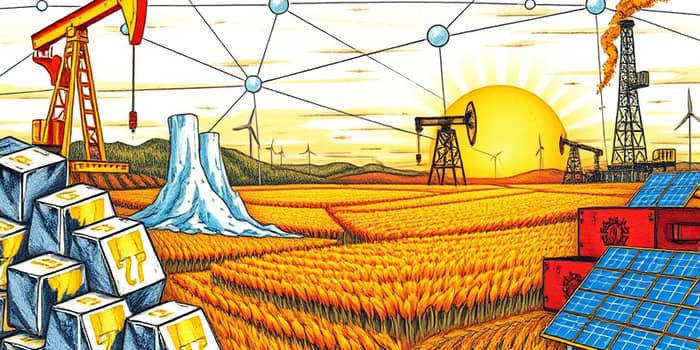
In an era defined by rapid shifts in supply, demand, and policy, the raw materials market stands at a crossroads. Investors and professionals must stay vigilant as traditional dynamics collide with emerging forces.
The following analysis equips readers with actionable insights to navigate volatility, harness opportunities, and build resilient portfolios in 2025 and beyond.
Market Overview & Key Trends (2025-2026)
Commodity prices are forecast to fall by about 12% in 2025, and an additional 5% in 2026, reaching a six-year low. More than half of traded commodities face declines exceeding 10% next year.
Weak global economic growth is at the heart of this downturn. Industrial demand remains sluggish as developed markets contend with tightening financial conditions and persistent inflationary pressures.
Moreover, high volatility in price movements—unmatched since the early 1970s—has become the new normal, driven by geopolitical tensions, policy shifts, and climate-related disruptions.
Sector-Specific Dynamics
While broad-based declines are expected, each commodity grouping tells its own story. Understanding these nuances is critical for targeted strategies.
These projections underline the variance in supply-demand dynamics and policy impacts.
- Oil & Energy: Brent crude is expected to average $73/barrel in 2025, dipping below $70 by year-end as production outpaces weaker demand. Meanwhile, solar capacity has surged over 160% in five years, reshaping the energy mix.
- Precious Metals: After gold’s record near $2,790/oz and silver at $35/oz in 2024, safe-haven demand may temper prices in 2025 despite ongoing inflation concerns.
- Metals & Minerals: Industrial metals may see stable to slightly rising prices due to steady demand for batteries and green technologies, though weak global growth caps broad rallies.
- Agriculture: Grain prices should trend higher amid La Niña benefits for North American yields, while soft commodities like coffee and sugar adjust downward as harvest conditions improve.
Major Risks and Uncertainties
Identifying and hedging against key threats is vital. Stakeholders must prepare for scenarios that could upend projections.
Economic risks: A sharper slowdown or renewed trade friction could exacerbate demand weakness. A strengthening US dollar further raises import costs for commodity buyers worldwide.
Geopolitical factors: Conflict flare-ups, sanctions, and OPEC+ supply decisions can trigger sudden price swings, especially in oil and gas markets.
Climate volatility: Extreme weather—droughts, floods, and heat waves—threaten agricultural yields and energy output, compounding supply chain disruptions.
Investment & Trading Strategies
Surviving and thriving in a deflationary environment demands disciplined approaches. Consider these tactics to manage risk and seize opportunities:
- Advanced risk management techniques: Use options and structured products to cap losses during drawdowns and lock in gains when price spikes occur.
- Robust diversification frameworks: Combine energy, metals, grains, and softs to cushion against sector-specific shocks and smooth portfolio returns.
- Digital trade tools replacing legacy methods: Leverage blockchain-enabled Letters of Credit and electronic bills of lading to streamline financing in metals and mining.
- Public-private sector collaboration: Engage with governments and multilateral agencies to secure food and energy supplies, boosting resilience during crises.
Forward-Looking Perspectives
Will commodity cycles become shorter and sharper, or will structural trends level the playing field? Stakeholders should watch for three transformative forces:
Energy transition: As solar, wind, and biofuels penetrate markets, traditional oil and gas demand patterns will shift. Companies are already adapting executive compensation to favor profitability over pure production growth, aligning incentives with market realities.
Deglobalization and regionalization: Supply chains may reconfigure towards resource-rich regions, elevating the strategic importance of Latin America, Africa, and Asia as both producers and consumers.
Digital transformation: From trade finance to logistics, technology is reducing friction and opening new arbitrage channels. Early adopters gain a competitive edge in speed and cost efficiency.
Emerging Strategic Themes
Looking to 2030, several themes will dominate: the race for critical minerals powering electric vehicles, the balance between food security and climate resilience, and the interplay between policy shifts and market innovation.
Investors and traders who cultivate adaptability, maintain strong risk controls, and foster cross-sector partnerships will be best positioned to thrive in this dynamic landscape.
By integrating data-driven insights with forward-thinking strategies, professionals can chart a course through uncertainty, turning challenges into long-term value creation.
Embrace disciplined flexibility, leverage strategic alliances, and stay informed. These pillars will guide you through the next chapter of global commodities markets.
References
- https://globalmarkets.cib.bnpparibas/commodity-markets-energy-markets-2025/
- https://openknowledge.worldbank.org/entities/publication/02d005ef-e3d9-44f5-aada-8ba42663a743
- https://www.aberdeeninvestments.com/en-us/investor/insights-and-research/commodities-the-year-that-was-the-year-that-could-be-2025
- https://www.jpmorgan.com/insights/payments/payment-trends/commodities-market-trends
- https://brainworksinc.com/commodities-market-experienced-traders-2025/
- https://www.morganstanley.com/im/en-gb/intermediary-investor/insights/articles/commodity-outlook-2025-three-areas-to-watch.html
- https://www.fastmarkets.com/insights/key-topics/2025-commodity-market-outlook/