
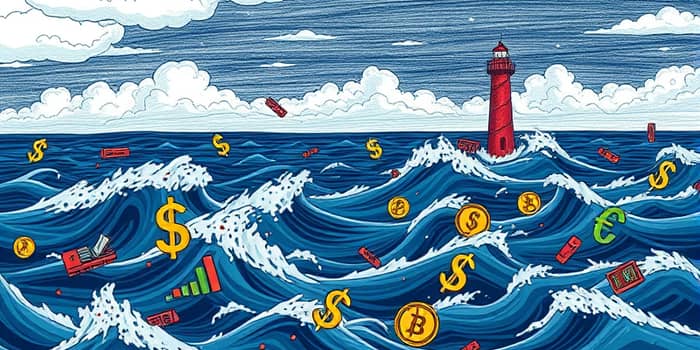
In a world where every headline can swing markets, understanding the signals beneath the surface is crucial for investors seeking stability and growth.
Defining Market Uncertainty in 2025
As analysts describe the economic environment with terms like the fog of uncertainty, they capture the volatility and unpredictability that has come to define the era. A recent survey by the World Economic Forum found 82% of chief economists rating global uncertainty as “very high.”
Key contributors to this turmoil include sudden tariff policy shifts, geopolitical tensions, inflation spikes, and the transformative impact of AI breakthroughs. While many economists foresee a gradual easing of some risks, underlying vulnerabilities remain deeply entrenched.
The Role of Market Signals
Market signals are the data points and indicators that professionals rely on to decode the overarching direction and risk in financial markets. They range from price adjustments to economic performance metrics, each offering a unique lens on market health.
- Price movements and trend reversals
- Volatility indexes such as the VIX
- Economic indicators like GDP and unemployment
- Bond yields and credit spreads
- Currency strength and capital flows
Key Market Signals and Their 2025 Data
Stock benchmarks & volatility: Early 2025 saw record highs followed by sharp drops when the S&P 500 entered a 20% correction triggered by unexpected tariff threats.
The CBOE Volatility Index, often called the “fear gauge,” spiked during these announcements and then normalized as policymakers paused aggressive measures.
Bond yields also rose sharply amid inflation concerns, reflecting a widespread expectation of tightening monetary policy. These movements underscored how policy-induced volatility in asset prices can reshape market sentiment overnight.
In currency markets, the U.S. dollar weakened significantly in early 2025 under pressure from trade uncertainties and shifting global capital allocations. Such currency fluctuations serve as a barometer for international investor confidence.
On the economic front, global growth projections for 2025 stand at 3.0% according to the IMF, while the World Bank offers a more conservative 2.3% outlook. The U.S. economy itself contracted by 0.3% in Q1 before projecting a rebound of 2.4% in Q2, demonstrating the gap between hard output data and soft forward indicators.
Labor markets provide another vital signal. With U.S. unemployment holding at 4.2% in May, rising unemployment claims and an uptick in public sector job cuts hint at early warning signs. Globally, nearly half of economists anticipate net job losses as AI adoption accelerates, making this a critical area of focus.
Finally, specialized uncertainty indexes reveal a 23% decline in macro uncertainty from December 2024 to April 2025, even as financial uncertainty climbed 13% over the same period. These measures, derived from news-based metrics and market data, highlight the complex interplay between easing policy risk and persistent market volatility.
Interpreting Market Reactions
Understanding how markets process these signals requires balancing quantitative data with qualitative sentiment analysis. While hard facts about growth and employment are essential, hard data and investor sentiment often diverge, leading to sudden price swings and strategic recalibrations.
Many businesses have postponed major investments. In fact, 87% of surveyed economists believe that delayed strategic decisions under policy dread could amplify recessionary pressures if uncertainty persists. Regional differences are stark: Asia-Pacific shows relative resilience, Europe remains cautiously optimistic, and North America grapples with mixed indicators.
Drivers of Uncertainty in 2025
Several core themes drive today's market unpredictability. First, evolving trade policies—including abrupt tariff announcements and renegotiations—inject immediate shock into global supply chains. Second, inflationary risks have re-emerged, potentially forcing central banks to reconsider planned rate cuts.
Perhaps most transformative is AI. As businesses race to integrate advanced systems, they face the dual reality of AI-driven productivity versus displacement. While technological adoption promises long-term gains, it also generates labor market anxieties and regulatory dilemmas.
Implications for Investors and Practical Strategies
In this dynamic landscape, investors must cultivate agility and foresight. A diversified portfolio can mitigate exposure to abrupt policy swings, while a focus on sectors with strong fundamentals provides a buffer against market gyrations.
- Emphasize diversification across resilient global sectors to spread risk.
- Monitor central bank communications for cues on monetary policy adjustments.
- Balance equity positions with high-quality bonds to smooth volatility.
- Stay informed on geopolitical developments affecting trade and technology.
- Incorporate scenario planning to anticipate potential economic shocks.
By combining rigorous data analysis with scenario-based planning, investors can harness strategic risk management and analysis to navigate choppy markets effectively.
Key Numbers at a Glance
Conclusion: Charting a Course Through the Unknown
While the path ahead is strewn with unforeseen twists, market signals offer a compass for investors seeking direction. By decoding the interplay between economic metrics, policy shifts, and technological disruptions, individuals and institutions alike can transform uncertainty into opportunity.
Ultimately, success in 2025 and beyond will hinge on the ability to blend quantitative rigor with strategic adaptability. Those who master the art of interpreting complex signals will find pathways to growth, even in the most turbulent of seas.
References
- https://www.privatebank.bankofamerica.com/articles/midyear-market-outlook-2025.html
- https://www.imf.org/en/Publications/WEO
- https://hbkswealth.com/insights/economic-uncertainty-2025/
- https://www.sydneyludvigson.com/macro-and-financial-uncertainty-indexes
- https://www.deloitte.com/us/en/insights/topics/economy/us-economic-forecast/united-states-outlook-analysis.html
- https://www.imf.org/en/Publications/WEO/Issues/2025/07/29/world-economic-outlook-update-july-2025
- https://www.weforum.org/stories/2025/05/wef-chief-economists-outlook-tariffs/
- https://www.worldbank.org/en/publication/global-economic-prospects