
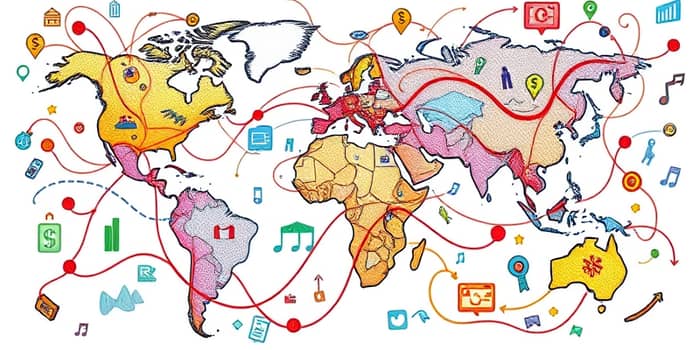
In an era defined by rapid change and complex interdependencies, the global market resembles an intricate tapestry woven by countless forces. From shifting growth projections to evolving consumer loyalties, each thread represents a connection—whether economic, political, or social—that shapes outcomes far beyond any one region. Understanding these dynamics is vital for businesses, policymakers, and individuals striving to navigate the challenges and seize the opportunities presented by an interconnected world.
Global Economic Outlook and Growth Resilience
After a period of uncertainty, the global economy is poised for a modest rebound. Projections estimate 3.0% growth in 2025 and 3.1% in 2026, reflecting renewed investment and fiscal expansion in key markets. Improved financial conditions and front-loaded business activity ahead of tariff adjustments have bolstered confidence across sectors.
Despite this optimism, persistent downside risks and uncertainty loom large. The potential for higher tariffs, intensifying geopolitical tensions, and market volatility could temper growth, underscoring the need for agile strategies that balance expansion with resilience.
Fragmentation and Regional Realignment
Talk of deglobalization has made headlines, but the truth is more nuanced. The world economy remains deeply interconnected global economy, even as relationships are reorganized along geopolitical and regional lines. Firms and governments are adopting friend-shoring, near-shoring, and on-shoring to bolster supply-chain security and reduce exposure to distant risks.
- China-leaning countries
- US-leaning countries
- Non-aligned connector nations
These emerging blocs reflect a reconfiguration, rather than a retreat, of global engagement. Each cluster leverages its own strengths while maintaining links to others through strategic partnerships and trade agreements.
Dynamic Global Flows
The strength of modern markets lies in the movement of goods, services, capital, data, people, and ideas. Over the past decade, digital and service-based exchanges have surged ahead of physical goods, reshaping value chains and competitive landscapes.
- Goods and services
- Capital and investment
- Data and digital services
- People and intellectual exchanges
None of the world’s regions operates in isolation. Even countries pursuing greater self-reliance rely on external inputs—from semiconductors and critical minerals to software and talent—that flow across borders in unprecedented volume.
Geopolitical Forces Reshaping Supply Chains
National security concerns and competitive rivalries are driving major shifts in sourcing strategies. In the United States, on-shoring and friend-shoring initiatives aim to safeguard supply chains and national interests, particularly in industries deemed critical for defense and technology leadership.
China, meanwhile, has influenced new trade corridors by incentivizing use of its ports, infrastructure, and digital platforms. Global companies are recalibrating their footprints to enhance resilience and minimize concentration risks, often maintaining parallel networks across different blocs.
M&A and Private Market Trends
Mergers and acquisitions paint a picture of cautious growth. Deal volumes in the first half of 2025 fell 9% year-on-year, potentially leaving total annual transactions below 45,000—the lowest level in a decade. Yet deal values are up 15%, driven by mega-deals valued over $1 billion.
Regional standouts such as India (+18% activity) and the Middle East (+13%) demonstrate that opportunities persist in dynamic markets. Technology remains the powerhouse sector, even as finance, healthcare, and energy see strategic consolidation.
In private markets, the influence of artificial intelligence is unmistakable. Half of all AI-related venture capital deals now occur outside North America, reflecting a global diffusion of innovation. Cybersecurity startups and fintech platforms in Brazil, Europe, and Asia are attracting unicorn valuations as they address local challenges with global relevance.
Consumer Localization and Brand Perceptions
Consumers are increasingly voting with their wallets, favoring locally owned companies over multinational giants. Surveys indicate 47% of shoppers globally now prioritize homegrown brands, driven by trust in local quality and supply-chain transparency.
European sentiment toward American brands has cooled—42% of consumers express less favorable views compared to early 2025. Meanwhile, Chinese and Japanese markets celebrate domestic champions: six of the top ten beauty brands in China and nine of the top ten snack brands in Japan are local enterprises.
For global corporations, the lesson is clear: adapt products, marketing, and sourcing to resonate with regional values. Embracing a strategic focus on core markets and agile local partnerships can transform turbulence into competitive advantage.
Sustainability, Interdependency Risks, and the Future of Globalization
Sustainability and risk management are two sides of the same coin. The pandemic and geopolitical crises exposed the dangers of overreliance on single-source suppliers. Companies are now diversifying inputs for critical materials and components to mitigate concentration risk.
Looking ahead, globalization will continue to evolve—driven by technological breakthroughs, shifting power dynamics, and societal demands for ethical transparency. The challenge lies in managing vulnerabilities of global dependencies while preserving the benefits of open exchange.
Ultimately, the global market tapestry will be rewoven time and again. Success will go to those who understand that every thread—economic policy, corporate strategy, consumer sentiment, or technological innovation—matters as part of a greater whole. By embracing complexity and cultivating resilience, stakeholders can navigate the shifting currents to build a more inclusive, sustainable, and prosperous global economy.
References
- https://www.imf.org/en/Publications/WEO/Issues/2025/07/29/world-economic-outlook-update-july-2025
- https://www.lesrencontreseconomiques.fr/2024/en/debats-idees/interconnections-in-a-fragmenting-global-economy/
- https://www.pwc.com/gx/en/services/deals/trends.html
- https://www.hinrichfoundation.com/research/article/sustainable/global-flows-the-ties-that-bind-in-an-interconnected-world/
- https://www.svb.com/trends-insights/reports/global-private-market-trends-2025/
- https://www.mckinsey.com/capabilities/strategy-and-corporate-finance/our-insights/global-flows-the-ties-that-bind-in-an-interconnected-world
- https://www.mckinsey.com/industries/consumer-packaged-goods/our-insights/state-of-consumer
- https://library.fiveable.me/key-terms/ap-world/globalization-of-economic-systems