
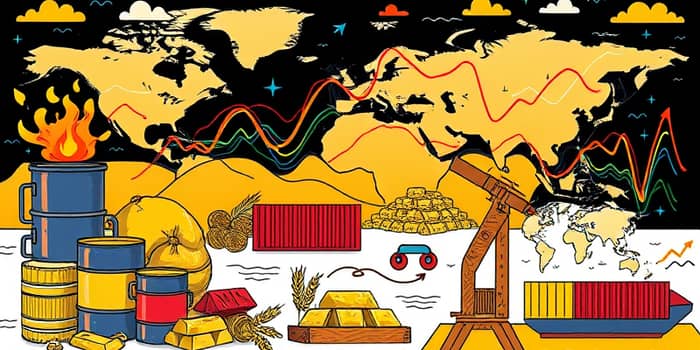
Commodity markets entered 2025 amidst renewed turbulence, leaving producers, consumers and investors scrambling to understand the forces at play. Prices are tumbling to levels unseen since 2020, driven by an intricate mix of geopolitical events, supply dynamics, economic shifts and currency movements. In this article, we explore the key trends reshaping global markets, offering insights and practical strategies to navigate this volatile commodity price environment and seize emerging opportunities.
Global Price Trends in 2025
According to the World Bank, global commodity prices are set to fall by 12% in 2025 and an additional 5% in 2026, marking a significant downturn. This dip reverses the post-pandemic rally and highlights the boom-and-bust cycles of recent years that have characterized the market. The average cycle length has halved since 1970, underscoring the need for market participants to adapt quickly.
Multi-year lows in key commodities—from energy to agricultural goods—have profound implications, affecting everything from government revenues in producer nations to input costs for manufacturers and food prices for consumers worldwide.
Geopolitical Tensions Amplify Market Uncertainty
Geopolitics has once again proven a potent driver of market swings. The promise of sweeping tariffs on imports to the United States has created a cloud of uncertainty over global supply chains. Retaliatory measures from major trading partners, including China, Canada and Mexico, threaten to disrupt agricultural and energy flows, intensifying price volatility.
Meanwhile, the threat of stricter sanctions on Iran looms, potentially crimping global oil supply. Regional conflicts in Eastern Europe, the Middle East and Asia continue to overshadow market fundamentals, with headlines capable of triggering sudden price spikes or collapses.
- Trade wars and tariff threats
- Sanctions on oil exporting countries
- Regional conflicts and supply risk
- Strategic reserves and stockpiling
Supply and Demand Dynamics Shaping Prices
The oil market embodies the classic struggle between supply control and demand realities. OPEC+ faces a dilemma: maintain production cuts to support prices or increase output to defend market share. In 2025, an anticipated rise in OPEC+ production could push prices even lower if demand fails to pick up.
- OPEC+ production strategies
- U.S. shale growth plateauing
- Weakening demand from China
- transition to electric vehicles reducing fuel consumption
Outside of oil, strong harvests in wheat and other grains have swollen global inventories, while steel and metal production in key economies has outpaced consumption. Agricultural markets remain sensitive to weather patterns—droughts and floods can rapidly shift the balance between surplus and scarcity, leading to unpredictable price swings.
Economic and Currency Factors
China’s economic underperformance has been a central factor in the recent slowdown of commodity demand. Manufacturing and construction activity in Asia’s largest economy have been weaker than expected, dampening consumption of oil, metals and other raw materials. Globally, growth remains solid yet unspectacular, leading to tepid incremental demand in 2025.
- Sluggish industrial activity in major economies
- Moderate global GDP growth forecasts
- Strength of the U.S. dollar against other currencies
- Potential disinflationary impact of falling commodity prices
Currency fluctuations play a critical role: a stronger dollar typically depresses dollar-denominated commodity prices, while a weaker currency can boost them. Market participants must monitor central bank decisions and forex markets to anticipate these cross-currents.
Market-Specific Impacts and Opportunities
Energy markets—including crude oil, natural gas, power and carbon credits—are expected to see continued volatility through 2025. As supply expansions meet muted demand, prices may remain under downward pressure. However, carbon markets could benefit from policy-driven demand for emissions credits.
In contrast, precious metals like gold stand out as a safe haven. Central bank purchases and investor hedging against inflation have driven gold prices higher, offering a counterpoint to the broader commodity slide. Agriculture faces headwinds from logistics bottlenecks and shifting consumption patterns, but also potential rallies if extreme weather disrupts supply chains.
Implications for Stakeholders
Volatility creates both risks and opportunities. Commodity traders often thrive when prices swing, leveraging derivatives and futures contracts to capitalize on short-term moves. Producers—oil companies, mining firms and farmers—must balance production decisions with storage and hedging strategies to protect margins.
Consumers of commodities, from food processors to airlines, can lock in input costs through forward contracts and options. Investors seeking diversification increasingly look to commodities as an alternative asset class, given their historically low correlation with equities and fixed income during periods of market stress.
Long-Term Outlook: Adapting to a New Normal
Ayhan Kose of the World Bank cautions that ever-changing commodity price cycles may become the new normal, driven by persistent geopolitical tensions and natural disasters. The surge in demand for critical minerals—needed for technologies like batteries and semiconductors—adds a strategic dimension to the market, fueling competition and price swings.
Developing economies reliant on commodity exports must build fiscal resilience, strengthen institutions and improve investment climates to weather repeated shocks. Diversification of economies, sustainable management of natural resources and regional cooperation will be key to stabilizing income streams and funding social programs.
In a world of shifting supply chains and uncertain demand, proactive planning and agile risk management are essential. Stakeholders who embrace advanced analytics, scenario planning and strategic hedging will be best positioned to navigate the ups and downs of 2025 and beyond.
Ultimately, understanding the interplay of geopolitics, supply and demand, economic growth and currency movements empowers decision-makers to transform uncertainty into opportunity. By staying informed, diversifying portfolios, and adopting flexible strategies, market participants can chart a course through the turbulence—turning potential pitfalls into pathways for sustainable growth.
References
- https://www.worldbank.org/en/news/press-release/2025/04/29/commodity-markets-outlook-april-2025-press-release
- https://globalmarkets.cib.bnpparibas/commodity-markets-energy-markets-2025/
- https://www.morganstanley.com/im/en-gb/intermediary-investor/insights/articles/commodity-outlook-2025-three-areas-to-watch.html
- https://www.aberdeeninvestments.com/en-us/institutional/insights-and-research/commodities-the-year-that-was-the-year-that-could-be-2025-inst
- https://www.oxfordeconomics.com/resource/five-key-commodity-trends-to-watch-for-in-2025/
- https://pmc.ncbi.nlm.nih.gov/articles/PMC7162753/
- https://www.gtreview.com/magazine/the-commodities-issue-2025/what-2025-may-bring-to-commodity-markets/
- https://www.investopedia.com/terms/c/commodity-market.asp