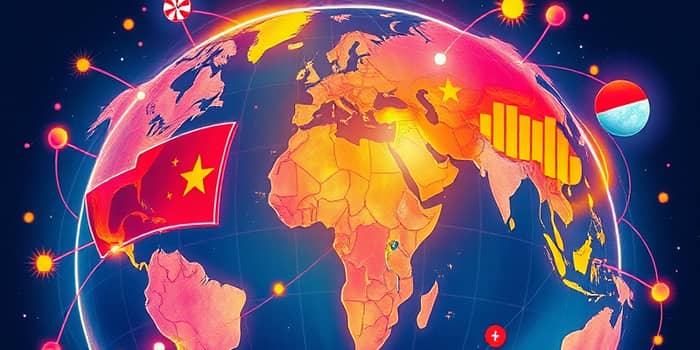
As we step into 2025, the world economy is characterized by both established powerhouses and rising stars. The latest IMF World Economic Outlook data reveals a landscape in flux, where traditional leaders consolidate their influence while emerging players chart new courses. By examining the world’s largest economic engines, we can gain insights into the forces fueling global prosperity.
From technological innovation in North America to industrial might in Asia, each nation contributes uniquely to collective growth. Understanding these dynamics offers a blueprint for policymakers, investors, and entrepreneurs seeking to harness unparalleled growth and investment opportunities in an interconnected market.
Understanding the Economic Landscape
Gross domestic product, or GDP, serves as the ultimate benchmark for global prosperity, aggregating consumption, investment, government spending, and trade balances. The formula Y = C + I + G + (X − M) distills these components into a single metric, allowing comparisons across nations. While nominal GDP measures output at current exchange rates, purchasing power parity (PPP) adjusts for cost-of-living differences, offering additional perspective on domestic well-being.
GDP per capita further refines this picture by dividing total output by population, a method that illuminates average living standards. High-income economies often pair substantial total GDP with impressive per capita figures, while populous nations may rank lower despite significant aggregate output. Recognizing these nuances is essential for a holistic view of global performance.
Leaders of Global Prosperity
The top economies in 2025 combine scale with sectoral specialization. The following table highlights the five largest nations by nominal GDP, showcasing growth trends and per capita figures.
The United States retains its crown as the largest economy, buoyed by a diverse mix of technology, finance, healthcare, and services. With a per capita income nearing $90,000, American consumers and businesses enjoy one of the highest standards of living worldwide. Policy decisions emanating from Washington and innovations from Silicon Valley continue to shape global trends.
China, as the second-largest economy, combines an extensive manufacturing base with a burgeoning domestic market. Its projected 4.8% growth rate reflects both robust export demand and a strategic pivot toward consumption. Despite challenges like mounting debt and demographic shifts, China’s economic momentum remains a critical driver of world’s economic balance shifting.
Germany stands as Europe’s powerhouse, specializing in automotive engineering, machinery, and chemical production. Although its growth is modest at 0.2%, Germany’s manufacturing prowess underpins stability in the eurozone. The nation’s focus on renewable energy and digitalization aims to bolster future competitiveness.
India, the fourth-largest economy, is the fastest-growing major player with an estimated 6.6% expansion. Spanning IT services, agriculture, and heavy industry, India’s diversified base supports both rural development and urban innovation. Experts predict that by 2028, India could surpass Germany to become the third-largest economy, a testament to its unprecedented growth momentum and scale.
Japan, renowned for its automotive and electronics sectors, rounds out the top five. While a slow growth rate of 1.1% reflects demographic headwinds, ongoing investments in robotics and artificial intelligence aim to reignite expansion.
Key Sectors Driving Growth
Several industries play pivotal roles across these economic giants, providing both stability and innovation. Leaders in different regions leverage unique strengths to maintain global influence.
- United States: Technology, finance, healthcare, services
- China: Manufacturing, exports, infrastructure development
- Germany: Automotive, machinery, chemicals, renewable energy
- India: Information technology, agriculture, pharmaceuticals
- Japan: Automotive, electronics, robotics, consumer goods
Emerging Economic Powers
Beyond the established giants, several nations are rising quickly, reshaping regional and global dynamics. Their trajectories offer lessons in policy reforms, resource management, and strategic growth planning.
- India: Poised to exceed $5 trillion by 2027, supported by domestic reforms
- Guyana: Experiencing rapid expansion thanks to offshore oil revenues
- Indonesia: Expanding middle class and tech startup ecosystem
- South Sudan: High growth rates from baseline but small economic base
These emerging players underscore the importance of adaptation and diversification in sustaining long-term growth. Investment flows and international partnerships will play an increasing role in their development.
Shaping the Future: Trends and Projections
As we look ahead, several themes will influence the trajectories of the world’s leading economies:
- Digital Transformation and AI integration
- Climate Action and Sustainable Investments
- Resilient Supply Chains and Infrastructure
- Inclusive Growth and Human Capital Development
Global trade patterns are also shifting, with supply chains diversifying beyond traditional hubs. Resilience against disruptions, whether from geopolitical tensions or environmental shocks, is now a core priority. Nations investing in infrastructure and human capital stand to benefit from enhanced productivity and social welfare.
For businesses and investors, data-driven insights for strategic planning enable stakeholders to navigate uncertainty and capture emerging opportunities. Ultimately, the collective performance of these economic engines determines the pace of global prosperity.
By tracking key indicators and adapting to evolving conditions, nations and enterprises alike can contribute to a more robust, equitable, and sustainable world economy.
References
- https://cleartax.in/s/world-gdp-ranking-list
- https://www.forbesindia.com/article/explainers/top-10-largest-economies-in-the-world/86159/1
- https://www.cerityglobal.com/blogs/top-15-countries-by-gdp-2025/
- https://www.worldometers.info/gdp/gdp-by-country/
- https://en.wikipedia.org/wiki/List_of_countries_by_GDP_(nominal)
- https://statisticstimes.com/economy/projected-world-gdp-ranking.php
- https://www.imf.org/external/datamapper/index.php
- https://www.youtube.com/watch?v=DSZGVqC42XI
- https://www.visualcapitalist.com/ranked-the-worlds-largest-economies-in-2026/