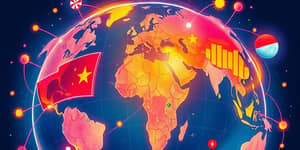
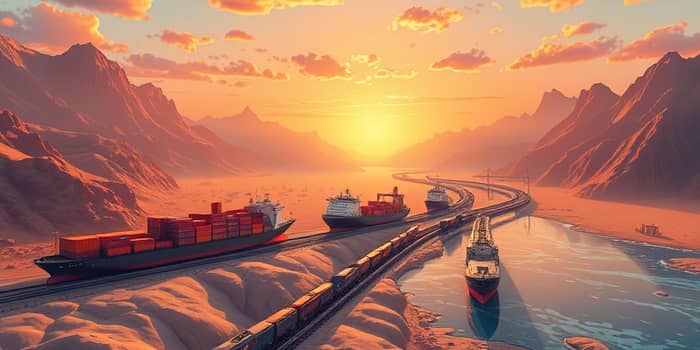
Asia is witnessing a profound shift as the New Silk Road reshapes its economic landscape. This strategic initiative has stirred global debate while driving unprecedented connectivity and growth.
Background and Scope
Launched in 2013 by President Xi Jinping, the Belt and Road Initiative (BRI) encompasses an overland Silk Road Economic Belt and a 21st Century Maritime Silk Road. It aims to revive ancient trade corridors with 21st-century infrastructure.
To date, 147 countries—representing about two-thirds of the world's population and 40% of global GDP—have joined or expressed interest. Investment has surpassed over $1 trillion in investment, with lifetime commitments possibly reaching $8 trillion.
Strategic Goals
The BRI pursues five official objectives that guide its expansive agenda. Through these pillars, China seeks to strengthen ties, create new markets, and stabilize economic partnerships.
- Policy coordination
- Facilities connectivity
- Unimpeded trade
- Financial integration
- People-to-people bonds
Long-term goals include channeling surplus industrial capacity, securing energy routes, and fostering regional stability through largest infrastructure initiative in history projects.
Geographical Reach
The BRI spans continents, from Central Asia’s steppes to coastal ports in Africa and Europe. It targets regions with critical infrastructure deficits, linking markets and resources.
- Overland routes: China through Central Asia to Europe, mirroring historic passages.
- Maritime routes: expanding deep-water ports across Southeast Asia, South Asia, East Africa, and the Mediterranean.
- Special economic zones: designated hubs in Indonesia, Vietnam, Pakistan, and beyond.
These corridors form a web of railways, highways, pipelines, and digital links, establishing green and sustainable infrastructure where possible.
Economic Impact
Asia faces an annual $900 billion infrastructure gap. By closing this deficit, the BRI enhances foreign direct investment, trade volumes, and employment prospects in emerging economies.
Case studies highlight transformative outcomes: modernized rail networks in Kazakhstan, upgraded ports in Sri Lanka, and energy pipelines in Central Asia. These developments are catalyzing profound economic transformation in recipient nations, though results vary by governance and local conditions.
Improved connectivity drives market access, supports small and medium enterprises, and underpins regional supply chains. The China-Pakistan Economic Corridor alone mobilizes a China-Pakistan Economic Corridor project valued at $62 billion, combining highways, railways, and port upgrades.
Political and Strategic Dynamics
The New Silk Road reduces reliance on maritime chokepoints and diversifies trade routes away from traditional Western-centered networks. It underlines China’s ambition to secure energy imports and raw materials through overland and maritime channels.
While India remains cautious due to border tensions and alliances, European and African partners view the initiative as an opportunity for economic advancement. Russia’s stance is mixed, balancing its historic influence in Central Asia with new cooperative projects.
Beijing emphasizes openness and inclusivity, advocating against protectionism and unilateralism. By mobilizing multilateral banks and national financiers, China extends the BRI’s reach beyond purely bilateral deals.
Criticism and Controversy
Critics warn of debt dependency and political leverage on recipient countries, highlighting opaque loan terms and project viability concerns. Transparency and accountability remain top questions.
Environmental advocates urge adherence to sustainability standards. In response, China has launched a “Green BRI” framework that promotes renewable energy projects and ecological safeguards along key corridors.
Academic analyses underscore that project success depends on local governance, economic readiness, and social impact assessments. Mixed outcomes in African and Southeast Asian ports illustrate both promise and pitfalls.
Future Outlook and Conclusion
As the New Silk Road evolves, stakeholders must balance ambition with responsibility. Strengthening regulatory frameworks, encouraging public-private partnerships, and prioritizing environmental protection will be vital.
Collaboration with the US, EU, and regional powers could foster complementary projects that amplify benefits and mitigate risks. By aligning with global sustainability goals, the BRI can drive equitable growth and stability.
In the coming decade, the New Silk Road has the potential to be a catalyst for regional integration, poverty reduction, and technological exchange. Its legacy will depend on transparent governance, mutual respect, and a shared vision for inclusive prosperity.
References
- https://www.cfr.org/backgrounder/chinas-massive-belt-and-road-initiative
- https://en.wikipedia.org/wiki/Belt_and_Road_Initiative
- https://greenfdc.org/belt-and-road-initiative-about/
- https://theloop.ecpr.eu/chinas-belt-and-road-initiative-re-evaluating-the-economic-impact/
- https://www.chathamhouse.org/2021/09/what-chinas-belt-and-road-initiative-bri
- https://carnegieendowment.org/posts/2023/12/how-has-chinas-belt-and-road-initiative-impacted-southeast-asian-countries?lang=en
- http://www.beltandroadforum.org/english/n101/2023/1010/c124-895.html
- https://www.fpri.org/article/2023/09/chinas-belt-and-road-initiative-politics-over-economics/
- https://monthlyreview.org/articles/one-belt-one-road-2/
- https://pubmed.ncbi.nlm.nih.gov/37065271/
- https://www.nortonrosefulbright.com/en-de/knowledge/publications/d2e05e9f/the-belt-road-initiative---a-modern-day-silk-road
- https://research.hktdc.com/en/article/MjA3MTA1MDA3OA
- https://www.carnegie.org/our-work/article/new-silk-road/
- https://www.congress.gov/crs-product/IF11735
- https://www.chinahighlights.com/silkroad/new-silk-road.htm