
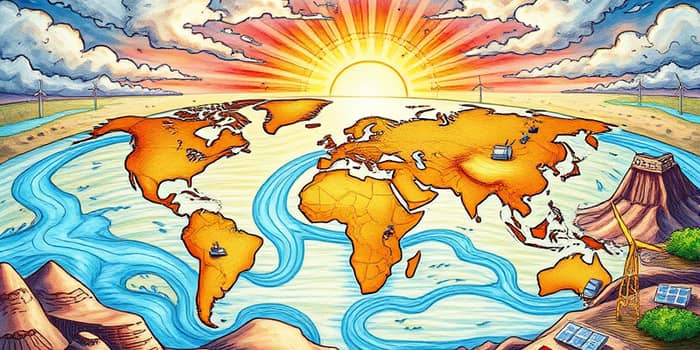
As humanity’s footprint expands, the competition for finite commodities intensifies. Investors, policymakers, and communities alike must navigate a landscape defined by scarcity and opportunity.
Introduction: The Era of Resource Scarcity
Global demand for essentials—water, energy, minerals, and fertile land—is surging. By 2060, global resource consumption is forecast to increase to 60% above 2020 levels, driven by population growth and urbanization.
These trends bring unprecedented challenges for food security, economic stability, and geopolitical harmony. As ecosystems strain under pressure, the very building blocks of development become contested.
Key Numbers and Trends
Understanding the scale and pace of scarcity is essential for crafting resilient strategies.
- 600 million people in 21 countries will face cropland or freshwater shortages by 2025.
- In 2022, 2.2 billion individuals—26% of the global population—lacked safe drinking water.
- By 2030, global freshwater demand will exceed supply by 40%, intensifying competition.
- Food insecurity hit 295 million people in 53 countries in 2024, fueled by conflict and extreme weather.
- Material use has tripled over the past half-century, amplifying environmental stress.
Climate change compounds these pressures: 2024 was the hottest year on record, and greenhouse gas emissions have climbed 50% in three decades.
Resource Scarcity Index and Investment Implications
To navigate complexity, analysts deploy a Scarcity Index that ranks resources by availability, renewability, and strategic criticality.
This index informs capital allocation by highlighting where supply gaps and demand spikes will drive value. Investors using this framework can anticipate markets most vulnerable to shocks or poised for growth.
By integrating these factors, investors can pinpoint sectors offering both resilience and returns in a world of tightening supplies.
Drivers and Consequences of Resource Competition
Scarcity stems from systemic pressures and human choices.
- Uneven geographic distribution of water and minerals
- Overconsumption in industrializing and wealthy nations
- Inefficient management and leaky infrastructure
- Climate change and extreme weather disruptions
- Political conflicts and trade barriers
These forces produce profound fallout. Heightened economic volatility, supply shocks, and price surges unsettle markets. Socially, forced migration and inequality intensify, while ecosystems suffer deforestation and biodiversity loss.
Heightened geopolitical tension and risk of conflict now shadow regions where water and arable land collide with rising demand.
Sectors and Assets Most Affected
Smart investors will target industries that alleviate scarcity or thrive amid constrained supplies.
- Water Infrastructure: desalination plants, treatment technologies, smart distribution
- Food Systems & Agriculture: precision farming, resilient crop varieties, vertical farming
- Energy Transition: solar, wind, battery storage, grid modernization
- Critical Minerals: lithium, cobalt, nickel, copper for batteries and electronics
- Circular Economy: recycling, remanufacturing, materials recovery
- Land Assets: sustainable farmland and carbon offset projects
These domains not only promise growth but also offer pathways to strengthen global resilience.
Risks and Strategic Responses
Investors must factor in policy volatility, trade tensions, and financial instability. Global growth projections of 2.7% for 2025-26 may falter under resource-driven inflation and supply chain bottlenecks.
Water conflict is ranked by intelligence agencies as a major geopolitical flashpoint. Meanwhile, protectionist measures risk fragmenting critical supply chains for minerals and agricultural inputs.
Successful strategies combine adaptation—such as climate-resilient infrastructure—with forward-looking regulations that incentivize sustainable practices.
Opportunities & Solutions
The race for resources can catalyze innovation. From novel desalination membranes to gene-edited drought-tolerant seeds, technological breakthroughs are reshaping possibility.
Decisive action and technological breakthroughs can decouple prosperity from resource depletion, creating more equitable and sustainable systems.
Circular economy models—recycling, reuse, remanufacturing—offer scalable means to reduce raw material dependency, lower emissions, and cushion markets from shocks.
Policy interventions must promote global cooperation, fair allocation, and incentives for impact-driven investments, aligning profit with planetary health.
Conclusion and Future Outlook
Resource scarcity poses a dual challenge: a test of global solidarity and a catalyst for transformation. Without coordinated effort, rising competition threatens food, water, and energy security, amplifying instability.
Yet within this crisis lies immense opportunity. Capital directed toward water, agriculture, clean energy, and circular solutions will generate sustainable returns and social benefits.
Policymakers, investors, and communities must collaborate to turn looming scarcity into a driver of innovation, equity, and long-term prosperity. In the race for resources, those who blend foresight with responsibility will shape a resilient future for all.
References
- https://www.circleofblue.org/2008/supply/drought/global-trends-2025-water-shortages-threaten-food-security-energy-supply-and-geopolitical-stability/
- https://openknowledge.worldbank.org/entities/publication/afcf0172-fb80-5c12-ae1f-2389a750a5cd
- https://www.wfp.org/publications/global-report-food-crises-grfc
- https://papers.ssrn.com/sol3/papers.cfm?abstract_id=5109582
- https://www.weforum.org/stories/2024/03/sustainable-resource-consumption-urgent-un/
- https://www.imf.org/en/Publications/WEO/Issues/2025/04/22/world-economic-outlook-april-2025
- https://www.arbor.eco/blog/sustainability-statistics
- https://www.masterclass.com/articles/resource-scarcity