
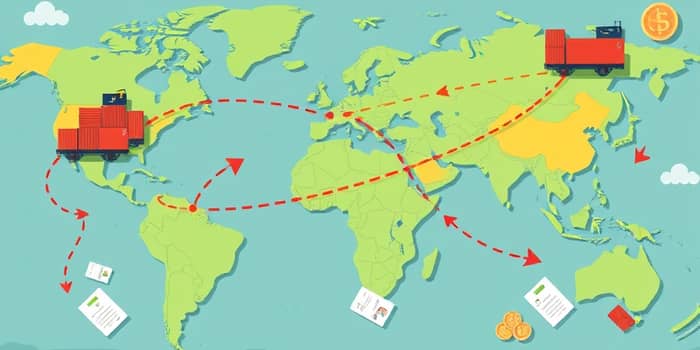
In an era marked by geopolitical shifts and economic uncertainty, the intersection of tax and trade policy holds the key to future growth and stability. This article unravels the complex layers of fiscal and commercial regulations shaping the world economy in 2025 and beyond.
The Global Macroeconomic Landscape
As we look toward 2025–2026, global growth projections present a mixed picture. The IMF and OECD anticipate an aggregate global growth forecast of 3.2% in 2025 and 3.1% in 2026, with advanced economies growing at roughly 1.5% and emerging markets exceeding 4%. Yet, the World Bank offers a more cautious outlook, estimating just 2.3% growth in 2025. These variances underscore the persistent uncertainties around inflation and the prevalence of downside risks.
Key headwinds include policy uncertainty, protectionist tendencies, labor market disruptions, and rising sovereign debt burdens. Against this backdrop, fiscal and trade measures are overshadowing monetary tools in importance, as governments deploy tariffs, rebates, and targeted spending to stabilize output and employment.
Emerging Trade Policy Trends
2025 has seen a surge in trade coercion and tariff use, particularly by the United States. Beginning April, a baseline 10% tariff applies to all imports, with steeper rates for major deficit partners until reciprocal concessions are secured. While front-loading before tariff imposition temporarily boosted trade flows, the long-term effects are sobering.
Economists estimate that these tariffs will shave 0.23 percentage points off US GDP growth in 2025 and 0.62 points in 2026. Increased input costs are translating into higher consumer prices and eroding competitiveness, even as businesses attempt to pivot supply chains elsewhere.
Global trade dynamics are increasingly mercantilist, with nations using export credits, digital services taxes, and retaliatory duties as leverage. The link between fiscal and trade diplomacy has never been stronger, with countries negotiating tariffs alongside tax treaties and investment agreements.
- US export growth projected at 0.6% in 2025 versus 3.1% import growth.
- Front-loaded import purchases in early 2025 inflated short-term volumes.
- Trade volatility driving winners and losers among exporters.
Major International Tax Reforms
The US "One Big Beautiful Bill Act," set to take effect in July 2025, redefines key corporate tax provisions. The Global Intangible Low-Taxed Income (GILTI) regime is replaced by Net CFC Tested Income (NCTI), reducing the Section 250 deduction from 50% to 40% while boosting the foreign tax credit on NCTI from 80% to 90%. Additionally, the Qualified Business Asset Investment (QBAI) rule is eliminated, reshaping how multinational firms allocate income and deductions.
Simultaneously, the Foreign-Derived Deduction Eligible Income (FDDEI) introduces a 14% effective tax rate on qualifying export revenue, and the Base Erosion and Anti-Abuse Tax (BEAT) edges up to 10.5% rather than the previously scheduled 12.5%. A new 1% excise tax on outward remittances rounds out the package, although exemptions for standard bank transfers mitigate some burdens.
On the multilateral front, 86 OECD/G20 jurisdictions continue implementing BEPS measures and Pillar Two minimum tax rules, albeit with carve-outs and transition delays. The result is a patchwork of national regimes that multinationals must navigate, creating create tax planning challenges on a global scale.
- Net CFC Tested Income replaces GILTI with adjusted deductions.
- FDDEI offers a 14% rate on foreign-derived corporate profits.
- Base Erosion and Anti-Abuse Tax set at 10.5% after 2025.
The Interplay of Tax and Trade Policy
Tariffs and tax incentives are not designed in isolation. High duties on imports can undermine domestic tax reforms aimed at promoting export competitiveness. Conversely, attractive tax holidays may lose value if retaliatory tariffs dampen market access.
Policymakers must balance revenue objectives with broader economic welfare. Tariffs deliver quick fiscal gains but risk long-term distortion, whereas robust tax bases—such as VAT or corporate income taxes—tend to be more stable and efficient. This tension frames much of today’s policy debate.
Moreover, governments are increasingly leveraging trade measures as fiscal tools, yet evidence suggests that protectionist tariffs often fall short of expectations. Instead of boosting net revenue sustainably, they can exacerbate supply chain fragmentation and inflate consumer prices.
In response, some nations are enhancing domestic tax incentives—such as accelerated depreciation or export credits—to offset tariff impacts. The result is a complex web of cross-border incentives and penalties, requiring businesses to adopt agile strategies.
Key Data Points at a Glance
Debates and Future Outlook
Several critical debates are shaping policy trajectories. Scholars highlight that tariffs are a weak, distortive revenue source compared to value-added or income taxes. They argue for a rebalancing toward broad-based taxation rather than piecemeal import duties.
Industrial policy is another flashpoint. Subsidies, sector-specific tax breaks, and targeted infrastructure spending can drive innovation, but poorly designed programs risk waste and heightened fiscal pressures. Finding the optimal mix of incentives and safeguards remains an ongoing challenge.
- Efficiency: comparing revenue yield of tariffs versus VAT and corporate taxes.
- Distributional impact: how trade and tax changes affect households and firms.
- Coordination: aligning US measures with OECD/G20 frameworks to avoid fragmentation.
The sustainability of public finances is also on the line. With sovereign debt at historical highs, governments must devise credible adjustment strategies that preserve growth and equity. Structural reforms in labor markets, infrastructure, and innovation policy will be indispensable.
Navigating the Path Ahead
Deciphering the global fiscal puzzle requires an integrated perspective. As tariffs, tax reforms, and fiscal stimuli converge, businesses and policymakers alike must stay agile, informed, and cooperative. Only through coordinated strategies can we mitigate risks, harness opportunities, and chart a stable path toward inclusive growth in an ever-evolving economic landscape.
References
- https://www.imf.org/en/Publications/WEO
- https://budgetmodel.wharton.upenn.edu/issues/2025/10/29/obbba-international-tax-reforms-updated-cost-estimates
- https://www.oxfordeconomics.com/key-themes-2025/
- https://www.wgcpas.com/new-international-tax-rules-highlights-from-the-july-2025-u-s-tax-reform-bill/
- https://www.imf.org/en/Publications/WEO/Issues/2025/10/14/world-economic-outlook-october-2025
- https://www.whitehouse.gov/fact-sheets/2025/04/fact-sheet-president-donald-j-trump-declares-national-emergency-to-increase-our-competitive-edge-protect-our-sovereignty-and-strengthen-our-national-and-economic-security/
- https://www.deloitte.com/us/en/insights/topics/economy/us-economic-forecast/united-states-outlook-analysis.html
- https://tax.thomsonreuters.com/blog/impact-of-tariffs-on-tax-and-trade/
- https://www.worldbank.org/en/publication/global-economic-prospects
- https://www.bakerlaw.com/insights/analysis-of-international-tax-changes-under-the-2025-tax-legislation/
- https://www.spglobal.com/ratings/en/regulatory/article/global-economic-outlook-q4-2025-global-resilience-battles-us-policy-unpredictability-s101647254
- https://www.pwc.com/us/en/services/tax/library/insights/tax-policy-outlook.html
- https://www.brookings.edu/articles/hutchins-center-fiscal-impact-measure/
- https://www.hamiltonproject.org/publication/post/tariffs-are-a-particularly-bad-way-to-raise-revenue/
- https://www.jpmorgan.com/insights/global-research/outlook/mid-year-outlook
- https://www.oecd.org/en/publications/tax-policy-reforms-2025_de648d27-en/full-report/tax-policy-reforms_c57e058c.html
- https://www.oecd.org/en/about/news/press-releases/2025/09/global-economic-outlook-weakens-as-policy-uncertainty-weighs-on-demand.html
- https://www.santander.com/en/press-room/the-year-ahead-2025/global-overview