
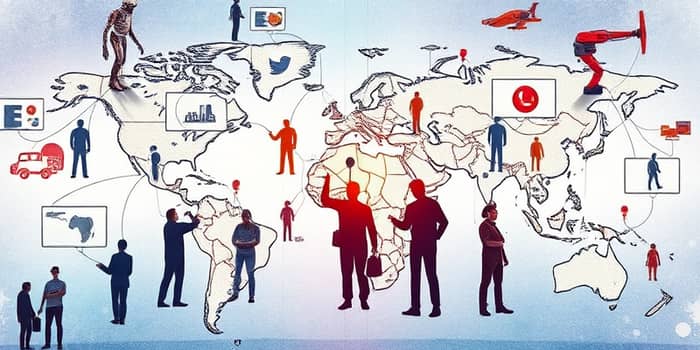
Since the dawn of the digital age, automation has been quietly reshaping the world of work. What began with mechanized looms and assembly lines has evolved into sophisticated AI systems capable of performing complex tasks once thought uniquely human.
As we stand on the cusp of transformative change, this silent revolution is challenging our assumptions about employment, skills, and economic growth. The outcome will depend on our collective response.
A Historical Lens on Labor Transformations
Every major technological leap has triggered fears of mass unemployment. During the first Industrial Revolution, steam power replaced artisanal weavers, yet new factory jobs emerged. The advent of electricity and automobiles brought similar disruptions, with labor shifting rather than vanishing.
In the late 20th century, computing and the internet created roles in software development, network administration, and digital marketing—fields that were unimaginable just decades earlier. Over 85% of employment growth since 1940 in the U.S. has come from entirely new occupations.
The Scope and Scale of Today’s Automation Wave
At a global scale, up to 300 million jobs could be lost to AI, accounting for roughly 9.1% of all roles worldwide. In the U.S. alone, 6–7% of the workforce—around 9 million workers—face potential displacement if AI adoption accelerates.
By 2030, projections indicate 92 million jobs projected to be displaced globally, but about 170 million new roles could emerge in fields like AI maintenance, robotics, and data science. Nearly 50 million entry-level U.S. positions are at risk from automation in the near term.
The pace of change is striking. While fewer than 10% of firms currently use AI regularly, adoption is accelerating among large and tech-forward companies. Experts estimate that automating half of today’s tasks worldwide could take another 20 years, with 2045 marking a milestone where 50% of jobs might be automated.
Industries on the Frontlines
Certain sectors are bearing the brunt of this transformation. Roles that involve routine, predictable tasks are most vulnerable, but even knowledge-based professions are feeling the pressure.
- Clerical and administrative positions such as data entry clerks and secretaries
- Retail and banking jobs, with tellers and cashiers facing double-digit declines
- Manufacturing, where over 1.7 million U.S. roles vanished since 2000 due to mechanization
- Customer service and call centers, increasingly served by AI-driven chatbots
- Professional services like medical transcription and routine legal work
Even scientists, engineers, and designers are not immune. Advances in generative AI threaten to automate aspects of research, coding, and creative processes.
unprecedented rapid technological acceleration is reshaping the once-clear division between manual labor and white-collar work.
Displacement vs New Opportunities
The narrative of doom overshadows a crucial fact: new roles could be created, but they rarely match the losses in skill type, location, or pay. Historical precedents show that technology reallocates labor rather than eliminates it entirely.
Examples from the gig economy illustrate this dynamic. Platforms like Uber lowered barriers for drivers, creating millions of new jobs, even as taxi dispatch roles dwindled. Yet the net effect on earnings and stability remains mixed.
- AI trainers and prompt engineers
- Ethics and policy specialists guiding algorithmic systems
- Data annotators ensuring high-quality machine learning inputs
- Robotics maintenance and integration technicians
Ultimately, career transitions demand significant investment in education, mentorship, and financial support.
The Evolving Skill Landscape
By 2030, an estimated 14% of global employees will need to switch careers entirely. In the U.S., 20 million workers are expected to retrain for new fields or learn to work alongside AI within three years.
Low-income economies face different challenges: only about 26% of jobs there are at high risk, compared to 60% in advanced nations. These disparities may widen global inequality if not addressed through international cooperation.
Reskilling initiatives must focus on creativity, critical thinking, and technological fluency—skills that machines cannot easily replicate.
Policy and Societal Implications
As automation burgeons, public policy will play a pivotal role in smoothing the transition. Governments and institutions must collaborate to ensure inclusive growth and opportunity.
Key measures include:
- Investment in continuous education and retraining initiatives
- Supportive transition programs between industries
- Strengthening social safety nets for displaced workers
- Incentivizing businesses to adopt AI responsibly
Without proactive policies, societal disparities could widen, leaving behind communities least equipped to adapt.
Looking Ahead
The next two decades may witness up to 50% of jobs automated, marking a deep and profound economic transformation. Yet history suggests that new opportunities will follow the initial upheaval.
Temporary rises in unemployment—estimated at 0.3 percentage points per 1% productivity gain—often give way to job creation as economies adjust. The question is how quickly and equitably that recovery occurs.
Though many businesses remain on the sidelines today, competitive pressures will drive broader AI integration, especially in sectors where efficiency gains translate directly to cost savings and innovation.
Embracing the Human Dimension
Behind every statistic lies a human story: the call center agent upskilling to become a data analyst, the factory worker transitioning to robotics maintenance, the mid-career professional embracing lifelong learning.
By fostering empathy, promoting access to education, and championing fair labor practices, we can guide this profound economic transformation toward a future where technology amplifies human potential rather than replaces it.
In this silent revolution, our choices today will define whether automation becomes a tool of empowerment or an agent of inequality. Let us choose wisely and act decisively.
References
- https://www.goldmansachs.com/insights/articles/how-will-ai-affect-the-global-workforce
- https://www.nu.edu/blog/ai-job-statistics/
- https://www.jpmorgan.com/insights/global-research/artificial-intelligence/ai-impact-job-growth
- https://www.weforum.org/stories/2025/08/ai-jobs-replacement-data-careers/
- https://hai.stanford.edu/news/assessing-the-real-impact-of-automation-on-jobs
- https://www.bls.gov/opub/mlr/2025/article/incorporating-ai-impacts-in-bls-employment-projections.htm
- https://www.brookings.edu/articles/new-data-show-no-ai-jobs-apocalypse-for-now/
- https://www.weforum.org/publications/the-future-of-jobs-report-2025/digest/
- https://budgetlab.yale.edu/research/evaluating-impact-ai-labor-market-current-state-affairs
- https://www.pwc.com/gx/en/issues/artificial-intelligence/ai-jobs-barometer.html
- https://www.nexford.edu/insights/how-will-ai-affect-jobs