
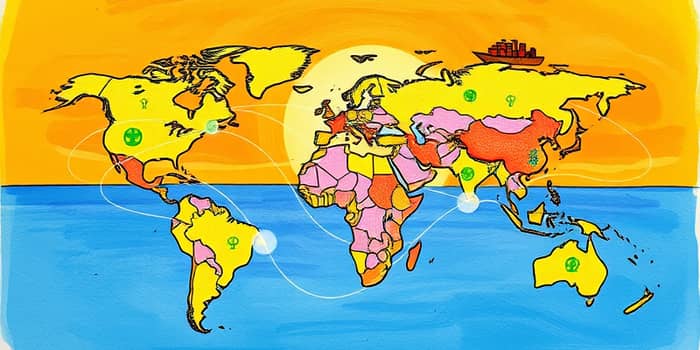
Global commerce is undergoing a profound transformation as traditional structures give way to new alignments. This article explores how emerging economic blocs are reshaping trade and outlines strategies for businesses and policymakers to thrive in this evolving landscape.
A Fractured Global Order
For decades, the global marketplace was underpinned by a longstanding WTO-anchored trading system that aimed to unite nations through common rules. However, recent years have seen that foundation crack under geopolitical pressure and stalled negotiations.
The shift from universal multilateral agreements to smaller, targeted arrangements reflects a reality in which comprehensive multilateral deals are stalling. Nations now prefer “coalitions of the willing,” forging plurilateral pacts on subjects like digital trade and economic security.
These new blocs emphasize coordinated standards for supply-chain resilience, mutual market access, and joint support for least-developed countries. By sharing rules on data governance and export controls, members build networks designed to withstand disruptions.
The Rise of Three Power Blocs
As of 2025, three dominant groupings shape global trade: the US-led coalition, the EU-centric partnership, and the China-centered bloc. Each reflects unique economic philosophies and strategic goals.
Beyond geography, these blocs embody contrasting models: a state capitalism in China and Russia versus more liberal protocols in Western alliances. Efforts to expand membership continue, from EU outreach to India to African Union engagement.
Quantifying the Economic Stakes
Emerging markets now account for 51% of global GDP in nominal terms and a commanding 66.4% of global GDP by purchasing power parity. This shift underscores the rising influence of non-Western economies.
The combined trade flows of major coalitions—US/EU/CPTPP members—could represent at least 50% of global trade. Such scale grants these blocs leverage to set standards in critical sectors.
Advanced technology, green energy, and digital services are high-stakes arenas where bloc strategies will play out. Control over semiconductors, rare earths, and renewable infrastructure will determine competitive advantage.
Major Deals and Policy Shifts in 2025
Several landmark agreements in 2025 have redrawn the trade map, reflecting both rivalry and rapprochement.
- US-China détente: On October 31, 2025, both sides agreed to suspend recent punitive import tariffs, resume large-scale agricultural trade, and lift restrictions on rare earth exports to the US.
- US-EU reciprocal framework: A new mechanism secures mutual market access while coordinating digital regulations and tariff rollbacks.
- AfCFTA progress: The African Continental Free Trade Area deepened integration, backed by EU technical support and investment pledges.
- Southeast Asian FTAs: The US inked agreements with Malaysia and Cambodia, expanding its footprint in a high-growth region.
These pacts illustrate how power centers blend cooperation and competition to safeguard their interests and solidify alliances.
Sectoral Dynamics: Tech, Green Energy, Digital Trade
New economic coalitions are prioritizing key industries to secure future growth and resilience.
- Digital trade and e-commerce growth
- Critical minerals and resource security
- Green technology and renewable energy
- Semiconductors and advanced manufacturing
In Southeast Asia, the internet economy is projected to reach $600 billion by 2030, driven by expanding fintech and e-commerce platforms. Meanwhile, blocs are erecting strategic stockpiles of rare earth elements to ensure uninterrupted production of high-tech goods.
Renewable energy projects, from solar farms in India to offshore wind in Europe, are entangled in trade diplomacy. Export credits and local-content rules have become tools of influence in green-tech supply chains.
Risks, Challenges, and Future Prospects
As alliances deepen, the dark side of fragmentation emerges. Excluded nations face higher costs and diminished market access, threatening their growth trajectories.
- Non-aligned countries risk marginalization in trade finance and technology transfer
- The WTO’s diminished authority undermines global rule consistency
- Supply chain splintering raises costs and reduces efficiency
- Conditionalities for developing economies can create dependency
Yet the emergence of smaller, nimble plurilateral pacts offers a path toward modernization. By focusing on shared interests—such as digital regulations or climate-linked tariffs—these agreements can innovate beyond stalemated global talks.
Looking ahead, two scenarios crystallize: one of deepening fragmentation leading to deglobalization, and another of “re-globalization” through flexible, inclusive networks. The latter demands trust, transparency, and a willingness to balance great power rivalry with cooperation.
Ultimately, forging resilient, adaptable supply chains and investing in digital infrastructure will determine which vision prevails. Policymakers and businesses alike must champion inclusive frameworks, ensuring that the benefits of trade are shared widely.
By embracing collaboration, innovation, and solidarity, the global community can transform competitive tension into a collective force for prosperity and stability. The reimagined trade order is not a zero-sum game; it is an opportunity to build a more equitable and dynamic world economy.
References
- https://www.realinstitutoelcano.org/en/analyses/the-emergence-of-a-new-global-trading-order-scenarios-for-global-trade-and-the-eus-role/
- https://www.fuqua.duke.edu/programs/executive-education/leading-global-business-strategy/emerging-market-outlook
- https://www.thompsonhinesmartrade.com/2025/11/u-s-and-china-reach-deal-to-ease-trade-tensions/
- https://fortune.com/2025/07/05/trump-tariffs-deglobalization-world-trading-blocs-gdp-impact-us-china-eu/
- https://www.tradecomplianceresourcehub.com/2025/11/04/trump-2-0-tariff-tracker/
- https://www.whitehouse.gov/fact-sheets/2025/11/fact-sheet-president-donald-j-trump-strikes-deal-on-economic-and-trade-relations-with-china/
- https://moderndiplomacy.eu/2025/10/16/a-new-era-of-trade-alliances-how-and-why-the-global-economic-map-is-changing/
- https://www.weforum.org/stories/2025/08/inflection-points-7-global-shifts-defining-2025-so-far-in-charts/
- https://policy.trade.ec.europa.eu/news/joint-statement-united-states-european-union-framework-agreement-reciprocal-fair-and-balanced-trade-2025-08-21_en
- https://economiclens.org/the-future-of-international-trade-how-economic-blocs-are-reshaping-the-global-economy/
- https://www.imf.org/en/Publications/WEO/weo-database/2025/april/groups-and-aggregates
- https://www.worldeconomics.com/Regions/Emerging-Markets/