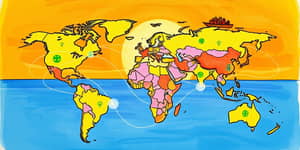
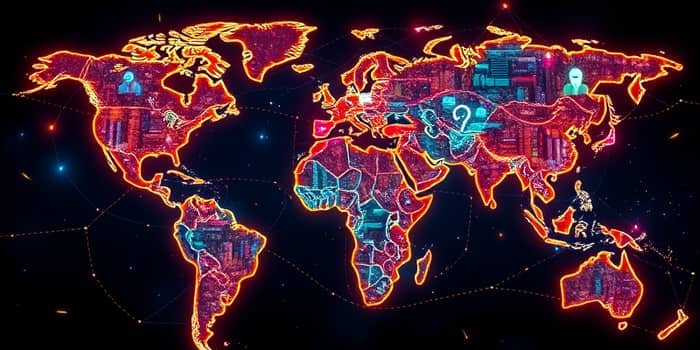
With the global order evolving into a system of multiple power centers, investors find themselves at a crossroads. Traditional benchmarks no longer guarantee returns, and regional dynamics demand a fresh perspective. This article explores how to harness the shifting tides of economic multipolarity and thrive in a fragmented world marked by innovation, risk, and opportunity.
Drawing on historical data, growth forecasts, and real-world case studies, we outline practical strategies that empower you to navigate uncertainty, diversify judiciously, and build long-term resilience. The journey ahead requires a blend of foresight, adaptability, and a willingness to embrace diverse markets with distinct cultural and regulatory landscapes.
Understanding Economic Multipolarity
Economic multipolarity describes a landscape where several nations or regional blocs command comparable influence over global GDP, trade flows, and technological progress. In contrast to the unipolar moment following the Cold War, power is dispersing toward Asia, Latin America, Africa, and parts of Eastern Europe. This rebalancing challenges investors to rethink assumptions built on decades of Western dominance.
In 1950, the United States and its major allies accounted for nearly 88 percent of global GDP; by 2025, advanced economies plus the old communist bloc represent only 57 percent. Such shifts underscore the dawn of multipolar economics, highlighting the rise of BRICS, ASEAN, and other dynamic players.
As power diffuses, supply chains are restructured through nearshoring and friendshoring, and currency debates fuel moves toward de-dollarization. Stakeholders must grasp the interplay of geopolitical forces and economic trends to anticipate where growth will emerge and how to position assets accordingly.
Key aspects of this transformation include:
- Dispersed economic power beyond the G7 and traditional blocs
- Rapid growth in BRICS nations and emerging market regions
- Supply chain restructuring through nearshoring and friendshoring
- Increased geopolitical influence of non-Western states
Opportunities in a Fragmented World
Amid fragmentation, investors can leverage emerging market growth trends and seize first-mover advantages. Technology hubs in India, renewable energy projects in Brazil, and digital finance ecosystems in Africa illustrate how localized innovation can generate outsized returns. Governments are crafting incentives to attract foreign capital, from tax breaks to streamlined regulations.
Consider how China’s Belt and Road Initiative is forging infrastructure links across Eurasia, or how Indonesia’s digital economy is leapfrogging legacy systems through cashless transactions. These case studies show that diversify across regions and sectors is more than a cliché; it is a pathway to uncover hidden value beyond traditional equity markets.
- BRICS expansion: Greater market access across eight member states
- ASEAN integration: A single market poised to rank fourth globally by 2045
- Technological leapfrogging in Africa: Mobile finance and renewable solutions
- Latin American commodity resurgence: Strategic resource investments
By building a portfolio that reflects these shifts, you tap into growth drivers that are less correlated with developed-market cycles and can outpace traditional benchmarks in the coming decades.
Risks and Challenges for Investors
While the promise of multipolarity is compelling, risks abound. Tariff disputes and trade policy uncertainty can derail supply chains at short notice. Currency volatility, especially amid de-dollarization experiments, can erode returns if positions are unhedged. Investors must deploy robust risk management frameworks and stay abreast of policy shifts in each jurisdiction.
Political risk remains a key concern, from sudden regulatory reversals in resource-rich countries to election-driven policy swings that affect foreign ownership rules. Conducting thorough due diligence on legal frameworks, understanding local business practices, and evaluating social stability are critical steps to mitigate exposure.
Practical Investment Strategies
Successful navigation of a fragmented world economy demands a disciplined yet flexible approach. Begin with country- and sector-level research, focusing on demographics, infrastructure needs, and long-term reform trajectories. A balanced allocation should build resilient supply chain networks, ensuring that no single disruption can upend your entire portfolio.
- Regional diversification: Spread capital across Asia, Africa, and Latin America
- Sustainability focus: Invest in clean energy and social infrastructure
- Local partnerships: Collaborate with domestic firms to navigate regulations
- Currency hedging: Protect returns against abrupt exchange rate shifts
To refine this strategy, consider using exchange-traded funds (ETFs) that track emerging-market indices, engaging local fund managers, or negotiating joint ventures with reputable businesses on the ground. Monitor performance metrics closely and rebalance portfolios quarterly to reflect evolving macro conditions.
As you refine your approach, remember to capitalize on shifting economic power balances by identifying early indicators—such as infrastructure spending and trade flow data—that point to rising regional stars.
Building Resilience and Partnerships
Embedding resilience into your investment framework goes beyond diversification. It involves cultivating robust risk management practices, scenario planning, and establishing clear exit criteria. Keep multiple contingency plans ready to address sudden regulatory changes or geopolitical shocks.
Key actions include: Establishing joint ventures to share resources and knowledge, implementing advanced risk assessment models for supply chains, monitoring geopolitical indicators to anticipate policy changes, and investing in training and talent development within partner countries. By aligning incentives and building trust with local stakeholders, you strengthen your ability to weather storms and capture long-term gains.
Embracing the Future of Multipolarity
The transition to an economic order shaped by many rather than a few opens new horizons for visionary investors. By combining deep research, flexible strategies, and reliable partnerships, you can thrive in a world defined by opportunities in dynamic regional blocs.
Ultimately, success hinges on embracing change as a constant. Stay curious, remain adaptive, and keep a global mindset that values both scale and nuance. The rise of multipolarity is not a temporary trend, but a new paradigm—one that rewards those who see complexity not as a hurdle, but as a canvas for innovation and growth.
References
- https://internationalbanker.com/finance/multipolarity-the-new-prevailing-reality-for-the-global-economy/
- https://research-center.amundi.com/article/multipolar-world-action
- https://www.un.org/sustainabledevelopment/blog/2025/05/press-release-wesp2025-2/
- https://behorizon.org/the-rising-importance-of-the-global-south-in-2025-a-new-pillar-of-multipolar-power/
- https://www.oecd.org/en/about/news/press-releases/2025/06/global-economic-outlook-shifts-as-trade-policy-uncertainty-weakens-growth.html
- https://securityconference.org/en/publications/munich-security-report-2025/introduction/
- https://www.stlouisfed.org/publications/review/2025/sep/measuring-geopolitical-fragmentation-implications-for-trade-financial-flows-policy
- https://trendsresearch.org/insight/analytical-review-of-the-msr-2025-a-multipolar-world-between-optimism-and-challenges/
- https://www.imf.org/en/publications/weo/issues/2025/07/29/world-economic-outlook-update-july-2025
- https://www.bcg.com/publications/2025/in-a-multipolar-world-global-south-finds-its-moment
- https://www.imf.org/en/publications/weo/issues/2025/10/14/world-economic-outlook-october-2025
- https://www.stimson.org/2025/an-american-strategy-for-a-multipolar-world/
- https://unctad.org/publication/trade-finance-and-reshaping-global-economy
- https://www.globalpanorama.org/en/2025/01/polycentrism-or-multipolarity-understanding-the-contemporary-international-system-unal-cevikoz/
- https://mronline.org/2025/02/20/what-is-a-multipolar-world/
- https://www.nato-pa.int/document/2025-geo-economic-fragmentation-report-kroon-016-esc