
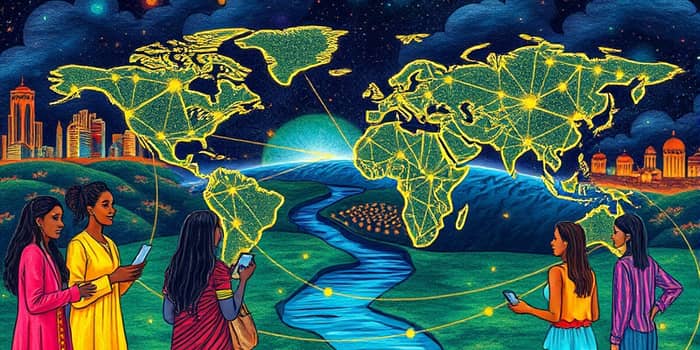
Understanding the digital divide is more urgent than ever. It extends beyond simple access, encompassing consistent and affordable connectivity that powers modern economies. By examining the latest data and exploring innovative solutions, we can chart a course toward inclusion and prosperity.
What the Digital Divide Means Today
The digital divide refers to the gap between those with reliable access to technology and those without. In 2025, this chasm spans multiple dimensions: infrastructure, affordability, device quality, and skills.
Meaningful participation now hinges on more than just being online—it demands high-speed connections, capable devices, robust digital literacy, and relevant services.
The Latest Global Figures
Current statistics underscore the divide’s scale and urgency.
These numbers reveal stark contrasts: over two billion people remain offline, while more than half the world cannot access high-speed broadband.
Beyond Connectivity: Devices, Skills, and Affordability
True inclusion involves multiple layers of access and capability.
- Connectivity: Physical infrastructure and cost barriers in underserved areas
- Device Access: The gap caused by old or shared hardware
- Digital Skills: The need for education and training to use technology effectively
- Relevant Content: Services tailored to diverse languages and cultures
Even where networks exist, outdated or shared devices restrict genuine participation in e-commerce or telehealth. Similarly, bridging this gap requires digital literacy and empowerment programs to build skills, and supporting localized and tailored online content to ensure relevance.
Economic and Social Impacts
Digital adoption correlates strongly with economic growth. Countries with robust digital infrastructure report faster GDP per capita increases, driven by innovation and enhanced productivity.
In the workforce, individuals lacking digital skills miss out on higher-paying roles, remote work, and the gig economy. Educationally, online learning widens inequalities when access is uneven, perpetuating socioeconomic disparities.
Public services—from AI-powered administration to digital health records—risk excluding those without proper identification or access. The divide deepens divides in civic engagement, healthcare, and social welfare.
Root Causes and Barriers
A complex mix of factors underpins the digital divide:
- Economic: Income inequality affects ability to purchase devices and services
- Geographic: Rural and remote regions often lack infrastructure investments
- Policy: Regulations can both foster and hinder inclusivity
- Disaster Risk: Natural hazards degrade and disrupt networks
- Demographics: Age, gender, and education level correlate with digital participation
Tackling these barriers demands coordinated efforts that balance technological, financial, and human-centered strategies.
Bridging the Gap: Solutions and Strategies
Effective initiatives span infrastructure upgrades, policy reform, and capacity building. Key approaches include:
- Expanding terrestrial and satellite networks to underserved areas
- Implementing affordable device financing models to reduce upfront costs
- Creating public-private partnerships for digital education to upskill communities
- Developing inclusive policies that simplify digital ID verification
- Investing in locally relevant platforms and services
By integrating these efforts, stakeholders can drive sustainable progress and ensure no community is left behind.
Stakeholders’ Role in Closing the Divide
Governments, international bodies, tech companies, and NGOs each play vital roles. Organizations like the ITU and World Bank provide funding and policy guidance, while telcos evolve into digital service enablers.
Collaboration is key: when public agencies work alongside private firms and civil society, they can launch scalable programs, deploy resources efficiently, and monitor impact in real time. This synergy creates resilient frameworks for long-term inclusion and empowers communities globally with inclusive e-governance and fintech services.
Case Studies and Lessons Learned
Real-world examples highlight both progress and persistent gaps. Refugees often face exclusion due to rigid digital ID requirements, demonstrating the need for flexible verification mechanisms. In the United States, urban-rural skill differentials persist even where connectivity is high, underscoring education’s role.
India’s low connectivity index score—affected by population density, poverty, and disaster exposure—illustrates how compounding risks can stall digital growth. These cases emphasize that context-specific solutions, backed by data and community engagement, yield the greatest impact.
Together, these insights reveal a path forward: by addressing each dimension of the divide and fostering collaborative partnerships, the global community can unlock unprecedented economic growth and social inclusion.
References
- https://blog.nuovopay.com/digital-divide-and-how-to-bridge-the-gap/
- https://www.brookings.edu/articles/fixing-the-global-digital-divide-and-digital-access-gap/
- https://sumsub.com/blog/digital-divide/
- https://datareportal.com/reports/digital-2025-global-overview-report
- https://pulse.internetsociety.org/blog/the-new-digital-divide
- https://www.etlsystems.com/news/global-connectivity-divide-how-big-is-the-gap-in-2025/
- https://www.itu.int/en/ITU-D/Statistics/pages/facts/default.aspx
- https://www.oecd.org/en/topics/sub-issues/digital-divides.html