
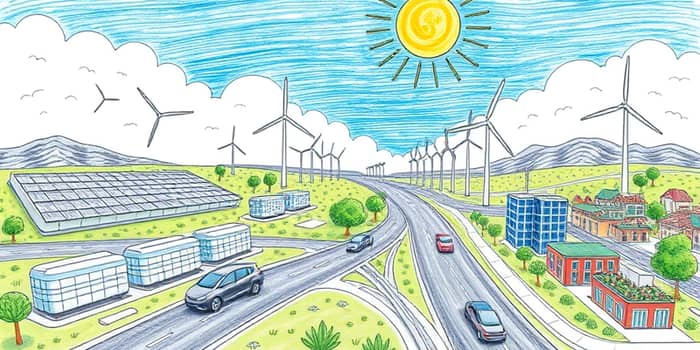
The global energy transformation is no longer a distant ambition—it is a powerful economic engine reshaping industries, creating jobs, and driving sustainable growth. As nations pour record investments into renewables, the world stands on the cusp of a new era where clean energy not only combats climate change but also unlocks unprecedented financial and social benefits.
Global Investment Revolution
In 2024, investment in clean energy reached an astonishing USD 2.4 trillion, marking a 20% surge over recent annual averages. Yet, to follow a net-zero pathway by 2030, annual funding must more than double to USD 5.6 trillion. Developing economies face the toughest challenge, with an annual investment gap of $2.2 trillion that risks leaving billions without access to modern power.
Only 15% of global clean energy funding currently flows to the Global South (excluding China). To correct this imbalance, investments in the region must grow five- to seven-fold, hitting USD 1.7 trillion per year by 2030. Closing this gap is both a moral imperative and a significant growth opportunity.
- Record-breaking global investment levels—USD 2.4 trillion in 2024
- Required annual funding to stay on track—USD 5.6 trillion by 2030
- Current share for developing economies—15% of clean energy spend
- Target for Global South investment—USD 1.7 trillion annually
Driving Economic Growth and Jobs
Clean energy isn’t just an environmental necessity; it is a potent economic catalyst. In 2023, the sector contributed to 10% of global GDP growth. China led with 20% of its growth driven by renewables, followed by the European Union (33%), the United States (6%), and India (5%).
Employment in renewables now tops 35 million worldwide, surpassing traditional fossil fuel jobs. In the U.S., the Inflation Reduction Act has spurred over 160 new or expanded clean energy manufacturing facilities, each promising thousands of high-quality jobs. Twenty of these facilities announced in late 2024 alone will yield at least 100,000 manufacturing positions and catalyze over USD 500 billion in additional investment.
- Clean energy jobs worldwide—35 million and growing
- New U.S. manufacturing facilities announced since 2022—160+
- Expected U.S. jobs from 2024 expansions—100,000
- Investment spurred in U.S. clean manufacturing—USD 500+ billion
Renewable Capacity Surge
The pace of renewable additions is breathtaking. In 2024, solar installations added 600 GW globally, wind contributed 125 GW, and grid-scale storage nearly doubled to 170 GWh. In the United States alone, a record 49 GW of solar capacity came online.
These expansions lifted renewables to 1,063 TWh of global electricity generation, making them the second-largest source after natural gas. Renewables supplied 83% of the increased electricity demand worldwide in 2024, with solar generation up 33% and wind up 7%. Experts predict renewables will overtake coal as the main power source by 2025, and by 2060, electricity’s share of global energy demand will climb from 21% today to 43%.
Rapid Cost Declines Unlocking Opportunity
One of the most inspiring aspects of this transformation is the solar module prices fell 35 percent to just USD 0.09 per watt in 2024. Battery costs for electric vehicles plunged below USD 100 per kWh, with critical components dropping 30–50% in price. These cost reductions deliver clean energy now cheaper than ever, making renewables and EVs accessible without hefty subsidies in many markets.
For businesses, this cost parity opens the door to invest in on-site solar installations, fleet electrification, and energy storage solutions, boosting resilience and profitability. Households and communities can leverage net-metering and financing programs to lower monthly bills and reduce carbon footprints.
Navigating Market Dynamics and Security
The shift from fossil fuels to clean technology has redefined global trade. Instead of oil tankers, container ships now carry solar panels, batteries, and critical components. This shift from tankers to container ships rewrites energy interdependence, reducing reliance on oil-exporting nations.
However, new strategic vulnerabilities emerge. China controls 70% of rare earth extraction and 90% of processing, prompting governments to diversify supply chains, expand domestic mining, and invest in recycling. De-risking critical material flows and supporting circular economies will be vital to maintain secure, affordable supplies.
- Diversify import sources for lithium, cobalt, rare earths
- Invest in domestic refining and recycling infrastructure
- Encourage public-private partnerships for strategic minerals
- Strengthen international cooperation on supply chain standards
Inclusive Transition and Policy Actions
While China and India spearheaded capacity expansions, many low-income countries prioritize basic energy access over decarbonization. For these nations, reliable power means economic growth—lighting homes, fueling industries, powering schools and hospitals. International financing must balance supporting emissions cuts with delivering universal access.
Policy ambition often surpasses market realities. Governments must close financing gaps by derisking investments, providing guarantees, and strengthening regulatory frameworks. The transition driven by economic momentum demands agile policies that adapt to rapid technological shifts and mobilize private capital.
Charting the Path Forward
The energy transition is not a cost—it is a gateway to prosperity. By aligning policy, finance, and innovation, the world can achieve a level playing field for clean technologies, accelerating decarbonization while boosting growth. Every stakeholder has a role: investors channel capital to high-impact projects, businesses integrate renewables into operations, policymakers craft supportive frameworks, and communities embrace sustainable lifestyles.
Key performance metrics—falling costs, rising capacity, job creation, and GDP gains—underscore an undeniable truth: clean energy is the foundation of tomorrow’s resilient economies. As we navigate challenges, from supply chain tensions to investment shortfalls, our collective action will determine whether this transition achieves its full promise.
Now is the moment to seize the opportunity. Let us invest boldly, innovate relentlessly, and collaborate inclusively to build a future where sustainable energy powers thriving economies around the globe.
References
- https://www.weforum.org/publications/fostering-effective-energy-transition-2025/in-full/redefining-global-energy-systems/
- https://rmi.org/the-energy-transition-in-2025-what-to-watch-for/
- https://www.stimson.org/2025/the-global-energy-transition-is-about-securing-the-future-not-managing-decline/
- https://wmo.int/media/news/un-report-renewable-energy-makes-economic-sense
- https://www.rff.org/publications/reports/global-energy-outlook-2025/
- https://www.wri.org/insights/clean-energy-progress-united-states
- https://www.dnv.com/energy-transition-outlook/2025/
- https://www.irena.org/Publications/2025/Jul/Renewable-energy-statistics-2025
- https://www.unepfi.org/industries/banking/the-trillion-dollar-opportunity-the-smart-economics-of-the-energy-transition/
- https://www.eia.gov/outlooks/aeo/
- https://www.irena.org/Publications/2025/Nov/Global-landscape-of-energy-transition-finance-2025
- https://www.mckinsey.com/mgi/our-research/the-hard-stuff-2025-taking-stock-of-progress-on-the-physical-challenges-of-the-energy-transition
- https://www.energy-transitions.org/new-paper-etc-addresses-global-trade-challenges-in-the-energy-transition/