
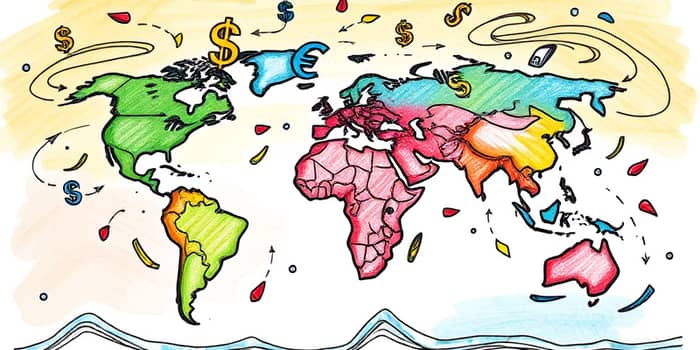
In an interconnected world, exchange rates shape economies, influence livelihoods, and test global cooperation. Understanding their fluctuations empowers you to navigate uncertainty and seize opportunity.
Definition and Core Concepts
A currency war, also known as competitive devaluations, unfolds when nations deliberately weaken their currencies to gain a trade edge. This strategy makes exports more attractive abroad, while imports become costlier at home.
By contrast, exchange rate volatility emerges from unpredictable fluctuations that affect trade. These swings reflect shifting investor sentiment, economic data releases, and geopolitical shocks.
Together, currency wars and volatility form a feedback loop: devaluations trigger market reactions, which provoke further policy moves and deepen uncertainty.
How Currency Wars Work
The core mechanism of a currency war is simple: a weaker currency boosts export competitiveness and shields domestic producers from foreign rivals. When one nation acts, others often respond, sparking a retaliatory cycle of competitive devaluations.
Sometimes these conflicts begin unintentionally. A government facing slow growth or high unemployment may cut interest rates or intervene in forex markets. Neighbors, unwilling to lose ground, enact their own measures, and soon a quiet tug-of-war erupts.
As devaluations multiply, exchange rates gyrate wildly. Firms struggle to price exports, importers face surging costs, and investors scramble for safe havens, amplifying global economic tensions.
Historical Context
The most infamous episode of competitive devaluations occurred during the early 1930s. Over seventy nations abandoned fixed gold standards, letting currencies tumble to revive flagging economies. Yet this widespread currency war of 1930s slashed international trade and deepened the Great Depression.
Since then, large-scale currency wars have been rare. Policymakers recognize the collective harm of devaluing in unison: global trade shrinks, capital flows buckle, and trust frays among trading partners.
Nine Common Causes of Exchange Rate Fluctuations
- Inflation differentials between countries
- Central bank interest rate shifts
- Economic contractions and recessions
- Speculative capital flows and market bets
- Equity market volatility influencing sentiment
- Political upheaval and policy uncertainty
- Investor risk aversion during crises
- Rising government debt and fiscal deficits
- Key economic indicators like GDP and trade balances
Each factor alone can sway a currency’s value; combined, they create a complex web that traders, businesses, and policymakers must unravel.
Recent Examples
In early 2025, newly imposed tariffs prompted the US dollar to shed 4% of its value within weeks. Markets fretted over supply-chain disruptions and rising costs, illustrating how policy shifts can fuel surging exchange rate volatility.
Similarly, the 2016 Brexit referendum sent the pound tumbling by nearly 12% in days, as investors fled uncertainty. This swift plunge underscored how geopolitical surprises can reshape currency markets overnight.
The 2008 financial crisis offers another lesson: in the face of global credit distress, traditional ‘risk-on’ currencies fell, while the yen and dollar surged as safe havens, revealing deep interconnections between equity markets and forex movements.
Consequences and Dangers
Unchecked currency wars threaten disruption of global trade volumes and heighten increased volatility in financial markets. Businesses face widened profit margins and unpredictably shifting costs.
Resource-scarce economies see import bills soar, eroding living standards. Central banks grapple with policy trade-offs between combating inflation and preserving competitiveness.
Ultimately, multilateral relations can fray as nations accuse each other of unfair manipulation, risking broader economic conflicts that hurt all parties.
Effects on Different Stakeholders
Businesses operating internationally must account for uncertain exchange rates hinder planning. Profit forecasts, pricing strategies, and supply-chain contracts all hinge on currency stability.
Central banks monitor volatility closely, balancing inflation targets against growth objectives. Emerging economies, with limited buffers, often bear the brunt, deterring investment and stalling development.
Investors seek safe havens—gold, government bonds, or ‘reserve’ currencies—during turbulent spells, underscoring the challenge of finding stability amid global shifts.
Fixed vs. Floating Exchange Rate Systems
Policy Response and Prevention
Major economies often condemn undisclosed forex interventions and emphasize fair competition. Central banks deploy tools—from interest rate adjustments to direct market operations—to temper extreme moves.
Yet no single nation can tame volatility alone. The crises of the past remind us of the urgent global policy coordination efforts needed to uphold stability, foster trust, and prevent destructive devaluations.
Practical Strategies for Businesses and Investors
While you can’t eliminate exchange rate swings, you can mitigate their impact. Applying strategic risk management techniques empowers decision-makers to adapt swiftly and confidently.
- Diversify your investment portfolio across asset classes and regions
- Implement hedging strategies against risks using forwards and options
- Monitor key economic indicators daily to anticipate policy shifts
- Engage in informed decision making by consulting cross-border experts
- Establish flexible pricing and supply-chain agreements
Proactive planning, flexible contracts, and continuous learning turn volatility from a threat into an opportunity for growth.
Conclusion
In today’s interconnected economy, exchange rate volatility is inevitable. Yet by grasping its root causes—from inflation gaps to geopolitical shocks—and adopting robust mitigation strategies, businesses and policymakers can navigate the storm.
Ultimately, fostering global collaboration, transparent policy frameworks, and sound risk management will help transform currency wars into a catalyst for innovation, resilience, and shared prosperity.
References
- https://www.currencytransfer.com/blog/expert-analysis/what-is-a-currency-war
- https://www.westernunion.com/blog/en/us/what-causes-exchange-rates-to-change/
- https://equalsmoney.com/financial-glossary/currency-war
- https://www.privalgo.co.uk/fx-volatility-what-causes-currency-appreciation-and-depreciation/
- https://en.wikipedia.org/wiki/Currency_war
- https://www.ofx.com/en-us/blog/exchange-rate-volatility-causes/
- https://fiveable.me/key-terms/international-economics/exchange-rate-volatility
- https://journals.sagepub.com/doi/10.1177/21582440241243200?icid=int.sj-abstract.citing-articles.1
- https://peif.conferences.wcfia.harvard.edu/file_url/216
- https://hbr.org/1986/07/volatile-exchange-rates-can-put-operations-at-risk
- https://www.spglobal.com/marketintelligence/en/mi/solutions/primer-currency-wars-and-foreign-exchange-manipulation.html
- https://pmc.ncbi.nlm.nih.gov/articles/PMC9803706/
- https://okoora.com/the-mechanics-of-currency-wars/
- https://cepr.org/voxeu/columns/exchange-rate-volatility-and-monetary-policy
- https://equalsmoney.com/global-business/what-is-rate-volatility